
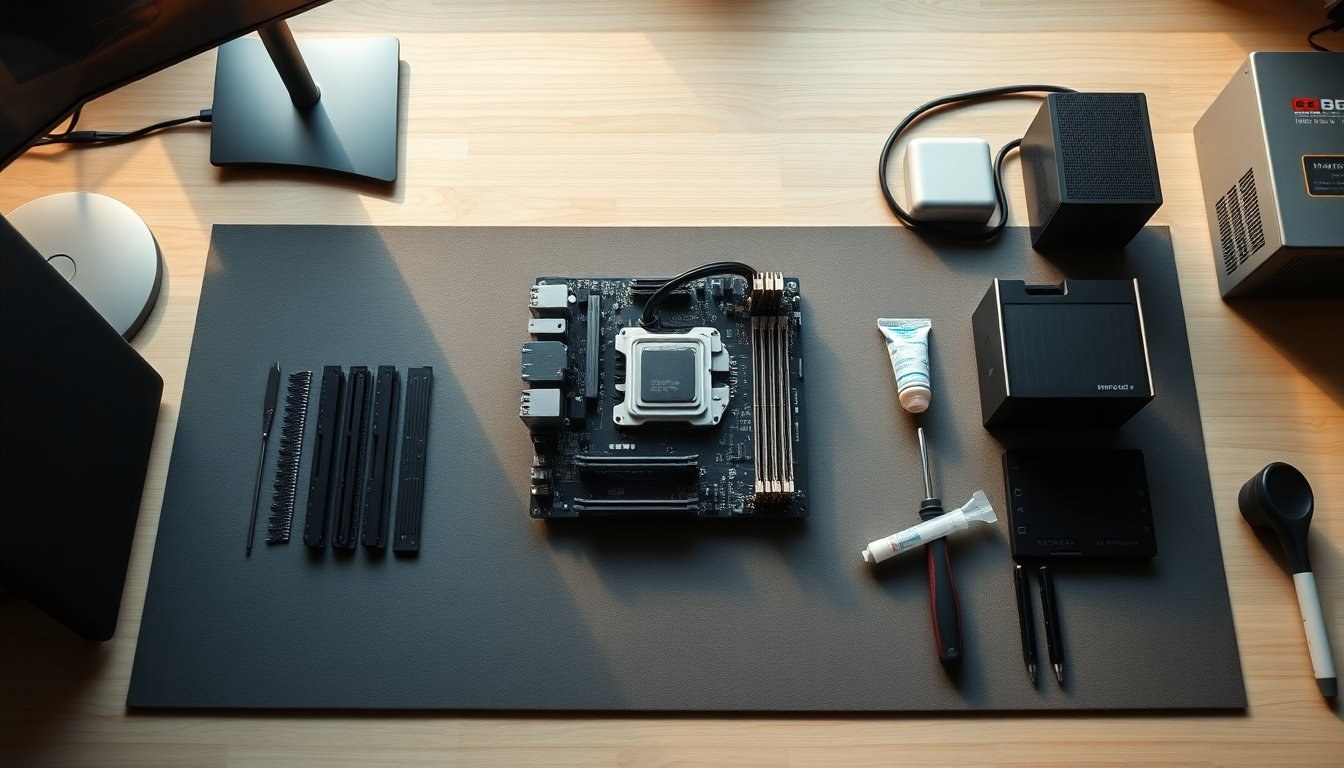
Putting together a high-performance gaming PC is less about buying the most expensive parts and more about choosing components that work well together. A thoughtfully assembled system delivers consistent frame rates, responsive input, and fewer thermal or stability issues than mismatched or poorly cooled setups. In this guide you will find a practical overview of what a custom gaming PC build means, why enthusiasts prefer it over prebuilts, and which decisions yield the most performance per dollar. Throughout the article we stress compatibility, cooling, and upgradeability so your machine stays relevant as games get more demanding.
Before you click “buy,” set a clear target for resolution and frame rate because that single choice drives almost every hardware decision. For example, 1080p prioritizes higher refresh-rate GPUs for esports titles, while 1440p and 4K require progressively more GPU power and faster storage for seamless load times. We’ll explain how to allocate your budget across the GPU, CPU, RAM, storage, motherboard, and PSU, and point out typical trade-offs. Expect guidance that helps you avoid common pitfalls like bottlenecking and poor airflow, and learn what to prioritize when building on a strict budget.
Why many gamers choose a custom build
Gamers frequently pick a custom build because it maximizes return on investment: you select parts tailored to your needs rather than accepting the manufacturer’s compromise choices. A custom configuration lets you invest heavily in a top-tier GPU for 1440p or 4K, combine it with a compatible CPU to avoid bottlenecking, and include a high-quality PSU so components remain protected. Custom builds also make future upgrades straightforward—swap the graphics card or add RAM without replacing the entire box. Finally, building your own system often results in better cooling layouts, fewer low-quality filler parts, and the satisfaction of assembling a machine that reflects your priorities.
Ten criteria to guide component selection
Prioritize GPU and balance the CPU
Start by allocating roughly 30–50% of your budget to the GPU if gaming is the main goal; this is the component that most directly determines playable settings and frame rates. Choose a card that matches your resolution goal—entry-level options suit 1080p, mid-range cards handle 1440p, and high-end GPUs are required for smooth 4K. Pair the GPU with a modern CPU that offers enough cores and high clock speeds to avoid performance loss. A mismatch here creates a situation where the CPU restricts the GPU’s output, an effect known as bottlenecking. Checking up-to-date benchmarks is essential for real-world expectations.
Memory, storage, power, and cooling
Use at least 16GB of RAM, with 32GB recommended for multitasking and heavy open-world games; DDR5 at higher frequencies provides extra headroom if your motherboard supports it. For storage, favor an NVMe SSD—Gen4 or Gen5 devices cut game load times dramatically compared to SATA drives, and a secondary HDD works for bulk libraries. Invest in a reliable PSU with an 80+ Gold or better rating and sufficient wattage (usually 750–850W for modern high-end GPUs). Finally, choose a case with good airflow and consider a 360mm AIO if you plan long sessions; keeping components below thermal limits preserves performance and longevity.
Recommended balance and pitfalls to avoid
An ideal mid-to-high-end build might pair an eight-core CPU with an RTX or RX-class GPU that has 16GB of VRAM, 32GB of DDR5 RAM, a 1TB NVMe Gen4/Gen5 SSD, and an 850W 80+ Gold PSU. A B650 or Z790 motherboard offers modern connectivity such as PCIe 5.0, USB4, and strong VRMs for future CPU upgrades. Avoid common mistakes: don’t mix incompatible sockets or memory standards, never skimp on the PSU, and keep case airflow high to prevent thermal throttling. Check warranties and reviews from trusted sources before buying to reduce the risk of early failures. By focusing on balance—matching parts to your performance targets and upgrade plans—you’ll get the most gaming value per riyal and a system that stays relevant longer.


